Saturday, January 21, 2017

"Where Ya At" - Future

"Your paper should be less comp bio and more co-biolog." When these words -- I like to call them revolutionary -- were uttered from Max's mouth with his trademark wink and smile, the other four of us in our group stared at each other in silence for a few seconds before we all cracked up.
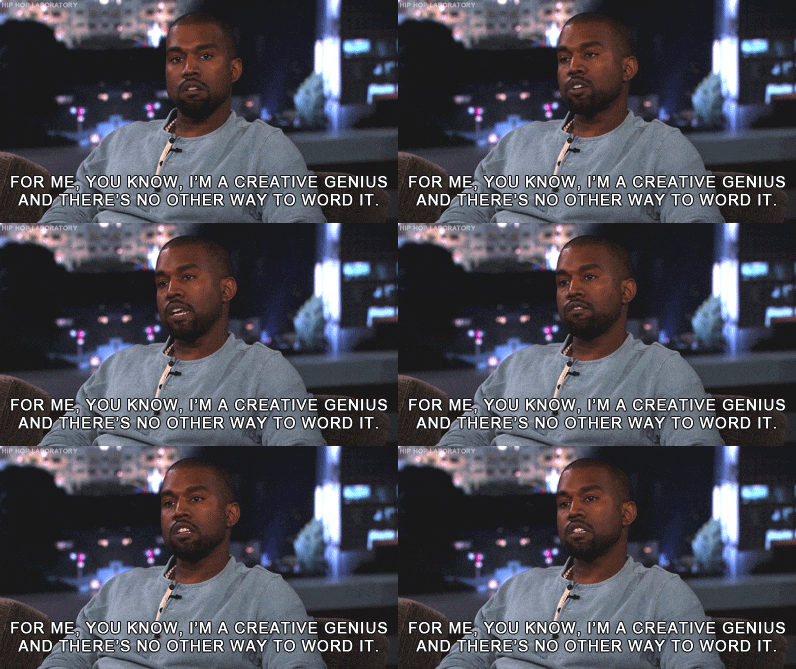
Max is the Kanye of AP Research
This anecdote pretty much sums up our group's feedback from last week; we all got some amazing feedback (in the above case, Divya was told to connect her research to the biological implications more) and had fun doing it. The critiques were really helpful, as I got a chance to look at my mistakes and the mistakes of others critically and carefully, and our group's discussions were a really good break from solely working on my project (jk. never... too much HemaDrop = ain't enough HemaDrop). 

After meeting with Mrs. Haag, I'm refreshed, prepared, and ready to revamp my lit review and methods combo package. In case you were wondering, some issues I was encountering were detached claims from justifications, lack of credibility descriptions, and a bit of unclear/esoteric parts of both. I will be submitting both in the next 2 weeks.

Since my project involves wet-lab work, I have already begun implementing my methods. I have prepared the coatings of various dilutions, acquired the necessary substrates, and made the pairs of identical samples (one for characterization with 3LCAA, one for blood analysis). I've been really fortunate to be able to get a head-start on this step, so I am excited about that!
I'm as happy as Drizzy (featured in this blog in honor of our OChem rap video)
However, I am slightly "behind" on analyzing the samples with 3LCAA and RBS because I idealized the process in my schedule slightly and I am waiting on some safety forms at ASU. I have a specific plan for making these up, with the logic that I can perform all the analysis from 3LCAA and RBS in longer session rather than 1 sample at a time. This way, I can standardize my results by limiting potential confounding variables from doing tests and different days, and it is more convenient once I have the apparatus set up on one day. So, rather than measuring a few samples each day, once the third trimester starts, we can perform the experiments in larger chunks, which is nice. Additionally, I can prepare the apparatuses and try to prevent major obstacles for the days until then (including preparing the samples, etc.).

On the point of preparation, Dr. Herbots has always emphasized to me the importance of preparation before conducting an experiment, so I am excited to add that I have been conducting simulations as a way of preparing for the results I will get and establishing what theory predicts the results should be. By doing these simulations on a program called RUMP (Rutherford Universal Manipulation Program -- a program made in the 1980s with FORTRAN), I am preparing myself for the results and will have a good comparison for the experimental data.

Example RBS spectra from RUMP

So far so good, except for the change in schedule, which made it easier and more feasible. The simulations have been taking up a lot of my time,for a journal paper, so I'm excited to present that data in my project too, since I think it's really interesting to compare simulations to data from the lab (and write up some preliminary results)! So, that's where I'm at...

I'm really excited to start working in the lab 3 times per week and getting some results! Thank you so much to Mr.s Haag, Rema, Kimy, Max, and Divya for helping me edit my methods and literature review.

Here's to another week of great research (IMPLEMENTATION)!

Cheers,
Yash

(625)
Monday, January 16, 2017

We're Back! And Reflecting on My Methods

Hey readers!

Phew... it feels so good to be back. After over 1 month without blogging, we are now going to be consistently blogging every week as school comes to a close (!?), and we all go our separate ways to implement our methods.

Senior year encapsulated with a meme...
Right now, we have submitted a working version of the methods section that will appear in our final papers. Now, our job for last week and the next week was to divide up into groups and fix our mistakes (they were plentiful, but it's all part of the process).

Although I will be receiving feedback from my group on this upcoming Wednesday, I think writing about what I perceived as strong and weak in my methods beforehand will allow me to critique my own methods from the lessons I learned last week and go into the feedback session with the methods fresh in my mind. So without further ado... let's do this!

The first weakness of my methods is the limited credibility that I used. This limitation was a by-product of my methods section exceeding the word limit of 1,000 words; the places where I tried to cut was the credibility because many sources overlap from my literature review. However, from going over other methods and doing a bit of introspection, I realize that some parts of my methods section are not supported fully. I need to fix this by explaining the methodology of the source and expanding upon the credibility of the authors.

In order to do this, I will have to fix another weakness of my methods: its length. I am 587 words over the word limit. I think the best spot to cut words is towards the beginning when I explain the type of method I chose. Although I tried to make this part extremely clear, it could be shortened. In my group editing session, I will also try to ask for spots that are unclear, as this often correlates with verbosity. One potential way for me to shorten my methods would be to insert my sample matrix as a table instead of describing it in so much detail (so the reader can see it). Max had a similar situation with this instructions. Just a thought?

Finally, I would like to explain some of the technical terms in my methods in more detail and more thoroughly because I feel that they were slightly esoteric (major L) at some points. These include the concepts of 3LCAA and Rutherford Backscattering and the qualitative markers of dis-uniformity.

These weaknesses sum up the general trend of my methods -- needing to say more in less space. However, I am confident that with the help of my group and by looking over my methods even more carefully, I should be able to mitigate these problems. Another solution would involve chopping 200 words or so from my literature review, so my word count is still on track. I am very happy with the level of detail I could provide about my method including the various validity and ethical precautions (except I forgot to talk about the course -- RIP).

Identifying these weaknesses is the first step, and by working on my methods with my group, I am confident that I can make my methods more concise, more understandable, and better!

We are optimistic on this blog, and for good reason!

Here's to another great week --  I will keep y'all updated on my progress on my methods and implementing my research! 

Talk to you next week (for real)!

Cheers,
Yash

(593)

P.S. I tried to experiment with the formatting/layout (doesn't deserve to be called an aesthetic) of my blog. Let me know if you think it looks worse or better!

Monday, December 12, 2016

Smooth Like Cocoa Butter

Hey readers!

This week, we turned in our methods proposals for IRB approval to the sweet smell of cocoa butter (If you don't smell like success, how can you be successful??).

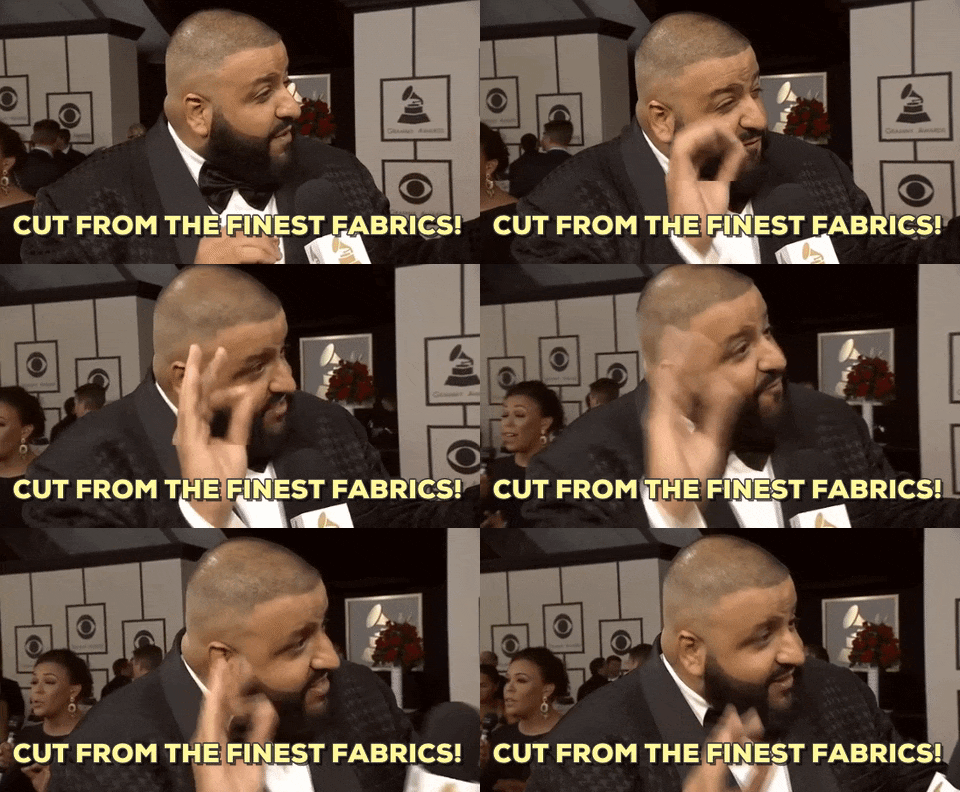
This blog is, in fact, special cloth talk.
I was able to write out the research design for my experiment, which is a mixed (quantitative and qualitative elements), prospective study. As I wrote about controls, confounding variables, and ethical precautions, I felt like a real researcher (which is, I guess, the point of this class). It's pretty cool stuff!

Wish me luck for getting approval!

Now, I have a plan for how to conduct my research, and by next week, I will even have my methods section done. I'm on top of the world!
I am Roy Williams.
But, wait. The hard part is coming up soon -- implementing the research. You know what they say: don't count your data before they hatch!

Congratulations... you played yourself.
Since I am employing mixed methods for a lot of sample combinations, I am going to start data collection in the lab before the 3rd trimester, so I'll start on December 26th (Happy Holidays?). Since I have to finish obtaining results by the middle of February, I will finish by February 20th. After that, I will need to finish analyzing my results and write up the results/discussion section and the conclusion. After all, final presentations are May 17th!

As DJ Khaled would say, "they" don't want us to plan our implementation out, so we got to plan our implementation out!

Here's my detailed plan for implementing my methods:


Week Tasks
1 (Dec 26 - Jan 1)
  • prepare substrates and coatings (all compositions and dilutions), 
  • apply coatings to samples to make 12 pairs of identical samples (1a - 12b), 
  • label the samples and create master spreadsheet, 
  • obtain consent from participant (and his parents), 
  • preparing 3LCAA apparatus
2 (Jan 2 - Jan 8)
  • perform 3LCAA on samples 1a - 12a, 
  • finish data analysis of 1a - 6a for 3LCAA images using Inkscape
3 (Jan 9 - Jan 15)
  • finish data analysis for 7a - 12a for 3LCAA images using Inkscape, 
  • extract blood and apply it to samples 1b - 3b, 
  • perform RBS on samples 1b -3b, 
  • finish code sheets for samples 1b-3b
4 (Jan 16 - Jan 22)
  • input final surface energy values into the master spreadsheet, 
  • analyze RBS results for 1b -3b, 
  • extract blood and apply it to samples 4b - 6b, 
  • perform RBS on 4b - 6b, 
  • finish code sheets for 4b -6b
5 (Jan 23 - Jan 29)
  • analyze RBS results for 4b -6b, 
  • extract blood and apply it to samples 7b - 9b, 
  •  perform RBS on 7b - 9b, 
  • finish code sheets for 7b -9b
6 (Jan 30 - Feb 5)
  • analyze RBS results for 7b -9b, 
  • extract blood and apply it to samples 10b - 12b, 
  •  perform RBS on 10b - 12b, 
  • finish code sheets for 10b -12b
7 (Feb 6 - Feb 12)
  • analyze RBS results for 10b -12b, 
  • compile quantitative measurements of uniformity for each sample, 
  • review qualitative coding sheets to establish gradation and create the scale
8 (Feb 13 - Feb 19)
  • TBD -- room in implementation for unforeseen delays or obstacles. 
  • or I finish implementation 1 week earlier, and can start writing up my results.

My implementation will be very iterative, since I want to treat all my samples identically. One benefit of this approach is that if I am ever running behind, I can make up time by simply spending more time in the lab to run more samples. The analysis of my data will involve finding the average difference in composition for elements like C, N, O, Ca, K, and Fe for 2 different spots on a sample (using absolute value of course to prevent cancelations). This will be the quantitative measure of uniformity. I will put this in a table with sample type, surface energy, and the quantitative measure of uniformity shown. Additionally, the qualitative data will rank each sample relatively compared to other samples in terms of cracking, cratering, phase separation, and moisture. The combination of quantitative and qualitative will let me characterize each sample. Additionally, example RBS spectra can be shown for individual samples in order to demonstrate that elemental composition can be found with HemaDrop analysis.

In mid-February, I will start writing up my results and discussion. In this way, I can have a final draft of my results by March 4 and edit tirelessly for a final research paper by March 20. By the end of April, I can have a polished presentation!

Sorry for the slightly late post...

Let's secure the bag this week in research, and keep wearing that cocoa butter, so everything goes smooth!

Cheers,

YP

(772)

Sunday, December 4, 2016

Elevating the Elevator Pitch

Hey readers!

This week, I worked on my Methods Proposal. For my blog post, we were given the task of making an elevator pitch!

Here is the video from YouTube. Hope you enjoy!


Let's have another great week of research!

Cheers,
YP

Tuesday, November 22, 2016

The Methods to My Madness

Hey readers!

It's been a productive few days -- here's what I've been up to! This past week, I've been working on my Methods Assignment, where we were given the task of honing in on the methods of 4 (I did 5) sources, examining their methods, and applying their findings to my initial idea of my methods. Since I turned it in yesterday, here's what some exciting new information I found.
Dab, Squidward...Dab!
Although going into this project, I definitely knew I'd need a quantitative method to perform tests to optimize the HemaDrop preparation method to create uniform thin solid films of blood. I was like Squidward in this parade: I knew what I wanted to do (dab, aka develop a solid experimental design), but I need some instigation.

Nonetheless, studying the methods of others allowed me to determine specifically the type of experimental procedure I want to conduct. Additionally, sources, like Acharya et al and Dar et al, emphasized the importance of using controls in experimental studies. In this way, I can prove causation from the results from using hyper-hydrophilic films by manipulating variables in a controlled manner.
Triggered...
Additionally, the important aspect of all procedures was the emphasis on consistent, reproducible sample preparation. For this, I definitely need to establish a clear protocol for sample preparation. Another aspect I realized about my methods was that to check sample variability, more participants should be used than just me. In this way, I can greatly increase the validity of my study. To get these participants, I will need to adapt our current IRB approval and consent forms to apply directly to my project. I feel good about this, as I was part of the IRB approval process at ASU, so I have some level of experience. The laboratories we work at are already Biosafety Level 2, which is required for obtaining human blood samples. In this way, my research will also be ethical. I will most likely use fellow interns as participants (convenience sampling), as they will be willing to be pricked (even though it's painless) and at the lab anyways.
That's me crossing over my methods section and nailing the 3-pointer.
An unexpected part of my methods that I uncovered with the methods assignment was that I definitely want to incorporate qualitative observations into my methods. As seen in Acharya's thesis, specific criteria like phase separation, cracking, cratering, and lack of uniformity can be used to classify samples and explain quantitative results. This will really give my research a holistic perspective that would otherwise be lacking.


I also realized that our procedure for capillary sampling can be much more streamlined. Although we did use the correct grade lancet for pricking finger tips, specific procedures, like those outlined in Fan et al, which employ rubefacients (dilate the capillaries) and capillary tubes, increase the validity of the results, as those are the standard of care for obtaining microliters of blood from patients.
Capillary sampling in action!
By following a more standardized procedure, our results can be more standardized and replicable.

Now... what am I worried about?? 
Rip...
A major concern that I have with my research right now is making sure I have enough time to collect data and perform all my experiments within a few weeks. I'm trying to fix this by planning out a clear schedule with Dr. Herbots and getting ahead on testing by starting in January (probably). By next week, I should have a clear picture of my research plan and get a headstart on my proposal!

Well, in the meantime, let's keep loving blood and doing some fun research!


Cheers,
Yash

(604)

Sunday, November 13, 2016

Started from the Bottom, Now I'm Here...

Hey readers!

Wow, it's been way too long... more than a month! Since I last posted, so many things have changed (good and bad) -- my literature review has been finished, I submitted some college applications, the weather is nice now, and Donald Trump was elected president. Other things haven't -- the Cardinals suck, the mini-dab is still fashionable, and Ashwath's memes are dank as ever.

Before I get into the meat of my post, I'm super excited to announce that at the 2016 American Physical Society Fall Meeting at New Mexico State University, I presented the research we've done so far on HemaDrop™ and got an award for best undergraduate presentation. Here's the link to a video of my presentation! The reason I'm talking about this experience on my blog -- apart from trying to maximize the views on that video -- is that I think that AP Research, Mrs. Haag and Dr. Herbots's help, the comments from you guys, and my literature review allowed me to understand and articulate information about my project in a way I never could before. So, thanks for that!
That's me getting the certificate and cash from Dr. Zaniewski!
Now, I'm going to talk about how far I've come, where I'm at, and what I have to do. First off, I think I've come a long way from the beginning of the year. Even though it may seem like I had an idea and project from the get-go, I have grown to embrace what I originally feared -- the actual mechanisms of creating a hyper-hydrophilic film. Before, the complexities of surface-energy coatings and substrate smoothness made me a nervous, but since that was where my research gap is, now I am all about those 2 topics. Additionally, I learned much more about the implications of my research and the importance of microliter blood analysis. Although I knew vaguely about anemia, I never understood the nuances of hospital-acquired anemia that I found through the conversation between sources like Thakkar et al, van der Bom et al, and Salisbury et al. Moreover, explaining my project to Mrs. Haag and writing it all out helped me think about HemaDrop in a completely different way, with greater connections between disparate parts like blood properties, hyper-hydrophilic films, and blood testing.

Right now, I've finished my literature review and started embarking on figuring out my methods. My job for the next trimester is to figure out how I want to answer my question and conduct my experiments. Although I know my methods will be quantitative, there are some qualitative aspects for describing samples, which I definitely want to have as part of my results. Additionally, I need to see how studies in the past have conducted testing with many different types of samples and analysis methods efficiently (trying all combinations in the best way to maximize information). Finally, I need to examine different analysis techniques (e.g., atomic force microscopy, three-liquid contact angle analysis, terahertz spectroscopy, RBS, and PIXE) and justify which ones are best to use for the data I want to collect.

Here's to more fun times in AP Research!

Cheers,
YP

(494)

Sunday, October 2, 2016

A (Face)Palmer: The Good, the Bad, and the Ugly

Hey readers!

I am writing this blog post immediately after watching the Cardinals lose to the LA Rams and drop to 1-3. My dad and I have resolved to stop watching games for the rest of the season... at least I'll have more time for AP Research! Unfortunately, this devastating loss was not the most embarrassing experience of my weekend.

On Friday afternoon, during a conference call with my research group, I was sharing my screen on Google Hangouts to explain how to analyze RBS spectra and create a compelling poster when the unexpected happened. As I readied myself to explain my insightful point about the data, my eyes widened with fear. A circle, greener than chloroplasts, with 3 curved lines resembling the convoluted endoplasmic reticulum of the endomembrane system (I honestly can't explain my desire to use cellular biology imagery right now) bounced up and down at the bottom of my screen.

A new black window covered up the picturesque poster I was displaying. My entire life flashed through my eyes as I realized the magnitude of what had just occurred. An accidental mouse-click had opened the beloved Spotify application, displaying to all viewers the infamous Hype/Ball playlist and the last song I was listening to by my favorite artist of the PRESENT (you all know who that is...): "I Got the Keys" by DJ Khaled, Jay Z, and (the one-and-only) Future. Stifled laughter from fellow interns echoed through speakers of my MacBook Pro, and I received 3 separate texts, 2 different Snapchats, and 1 Facebook message asking me if I knew I was still screen-sharing. I minimized the window quickly, and with it, my dignity.

I pressed the wrong KEY KEY KEY.
Now that we've all been triggered thoroughly, I'm going to talk about the good, the neutral (not bad?), and the ugly about my research project.

No caption needed -- too good.

  • The Good: I am very confident about the grasp I have of the motivations and mechanisms behind HemaDrop™. Compiling sources, writing, and presenting about my research has really allowed me to understand why this research matters, how HemaDrop works, and what methods we can use to analyze its viability. Additionally, I am very happy with the current research question I wrote on Friday (What properties of high surface-energy coatings and surface topography allow HemaDrop™ to optimize uniformity and analyzability of solid films created by congealing microliters of blood on substrates?) and new way of looking at this research I worked on with Mrs. Haag and Dr. Herbots recently. I had unknowingly developed a set frame of mind that was stifling my ability to describe our research from the beginning and to a general audience. I am also thrilled with the potential methods I get to plan and undertake for my primary research, as I am so curious to see how HemaDrop™ samples respond to various analysis techniques and with different substrate properties. Finally, I am excited with the extensive support system I have through AP Research and the Herbots research group. As long as I stay on track and ahead of schedule, I will be able to reach out for help on any aspect giving me difficulty.

 
Jay Z: Cold and emotionless -- neutral.


  • The Neutral: I have no strong feelings about my time management this year so far, since I have been trying to stay ahead of schedule, and I have been pretty solid in that regard. This is an area I can definitely improve on though. Additionally, I am neutral about writing the literature review, since I am a little nervous about constructing it in a compelling way, but I am also really excited to get writing, since it will allow me to show my understanding of my research so far. I guess those balance out into neutral.


I couldn't find a better GIF for the ugly, so here's DJ Khaled for the sake of symmetry


  • The Ugly: I am slightly concerned about the number of possible combinations required to test in order to optimize HemaDrop and analysis techniques. Even though I am trying to pick and choose the analysis techniques based on sources in my literature review (describing limitations and advantages of different techniques), I am a little terrified about having to test all of these combinations and analyze the results. However, I think my question leaves some room for the potential result that I can't find the exact optimal conditions, since I am investigating the new field and I can't find all the answers. Also, I think studying and planning my methods carefully will also help this process.
I hope you enjoyed this more light-hearted post than the last few weeks, since I definitely enjoyed writing it! And that's the KEY after all.

Here's to moving on to FUTURE fun and research...

Cheers,
Yash

(803)